Your Engagement Got Shorter — Now What Should Your Workouts Actually Focus On?

Quick Answer: A shortened engagement means trading the slow, broad approach of a full-year plan for a focused one built around what actually changes fast — posture, energy, muscular tone, and how you move in your dress. With 6-10 weeks instead of 12 months, the priority list shrinks to strength training, stress management, and sleep, while slower goals like major body composition change get set aside. Fewer priorities, done consistently, beat a long wishlist you don’t have time for.
If your date just moved up — whether it was your choice or circumstances pushed it — the first instinct is often panic about “not enough time.” But a shorter engagement doesn’t mean a worse-prepared version of you walking down the aisle. It means a different plan, built for what actually moves the needle fast.

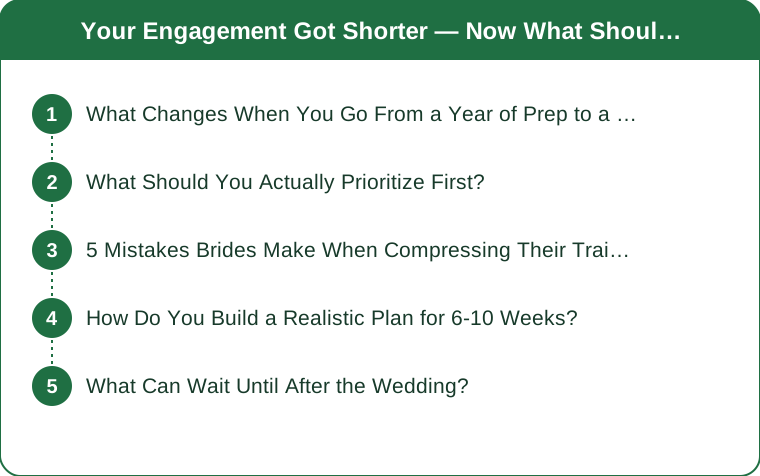
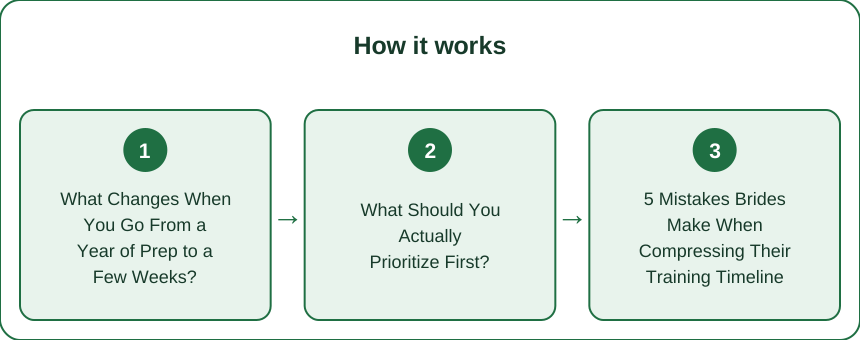
What Changes When You Go From a Year of Prep to a Few Weeks?
A full-year bridal fitness plan typically has room for phases: a few months of habit-building, a few months of steady strength progression, a cut or tone phase, and a final taper. Each phase can afford to be slow because there’s time to recover from a bad week or a plateau.
A compressed timeline removes that cushion. With 6-10 weeks, there’s no real room for a slow ramp-up phase — every week has to contribute directly to how you’ll look and feel on the day. That’s not necessarily bad news: the highest-yield changes for most people happen in the first 4-6 weeks of a new consistent routine anyway, thanks to neuromuscular adaptation (your nervous system getting more efficient at recruiting muscle) and posture correction, both of which show up well before slower changes like significant fat loss or muscle growth.
The real shift is in what gets deprioritized. A 12-month plan can chase multiple goals at once — strength, endurance, flexibility, and body composition — because there’s time for all of them to compound. A 6-10 week plan has to pick 2-3 priorities and let the rest go, because trying to do everything in limited time usually means doing all of it halfway.
This is also where mindset matters more than most fitness advice admits. A shorter runway paired with realistic, focused goals produces a far better outcome — and far less stress — than an ambitious plan borrowed from someone with 10 times the time you actually have.
What Should You Actually Prioritize First?
With limited weeks, three things consistently deliver the most visible and felt payoff: strength training, sleep, and stress management — in that order of active effort, though all three interact.
Strength training first because it’s the fastest lever for how your body looks and how your dress fits. Two to three full-body sessions a week focused on compound movements (squats, rows, presses, deadlift variations) build the posture and muscle tone that show up in photos faster than isolated cardio work does. Even 4-6 weeks of consistent resistance training produces visible changes in posture and muscle definition, driven initially by improved movement efficiency rather than slow tissue growth — which is exactly the kind of fast-acting change a short timeline needs.
Sleep is the most underrated lever on a compressed timeline, and it’s often the first thing wedding planning stress erodes. Poor sleep directly affects how your face looks (under-eye puffiness, dull skin tone) and how your body recovers between workouts — meaning skimping on sleep can actively undercut the strength work you’re prioritizing. Protecting 7-8 hours a night during a short engagement often does more for how you look and feel than an extra workout would.
Stress management rounds out the list because a compressed wedding timeline is, almost by definition, a higher-stress one — vendor decisions, guest logistics, and family dynamics all get compressed into fewer weeks alongside your fitness goals. Ten minutes of daily walking, stretching, or breathing work isn’t just a “nice extra” here; it protects your ability to stick with the other two priorities when the schedule gets tight.

5 Mistakes Brides Make When Compressing Their Training Timeline
1. Trying to cram a 12-month plan into 8 weeks. Doing every phase of a long plan at high intensity all at once usually leads to burnout or injury before the wedding, not better results.
2. Chasing body composition change as the main goal. Meaningful fat loss or muscle gain typically takes longer than a short engagement allows. Chasing it anyway often means missing the faster wins — posture and tone — that were actually achievable.
3. Cutting sleep to fit in more workouts. More training volume without adequate recovery doesn’t compound — it stalls progress and shows up as fatigue in your face and energy, which undercuts the whole point.
4. Adding a restrictive diet on top of a compressed workout plan. Two major changes at once, under time pressure, is a common recipe for abandoning both. Pick one lever (usually training) and commit to it fully instead.
5. Ignoring stress as part of the fitness plan. A shortened engagement is inherently a higher-stress period. Skipping stress management because it “isn’t a workout” often quietly undermines the strength and sleep priorities that are supposed to be the focus.
The through-line across all five: a short timeline rewards focus and consistency far more than it rewards intensity or ambition.
How Do You Build a Realistic Plan for 6-10 Weeks?
Start with a simple weekly structure: 3 strength sessions (30-40 minutes, full-body compound movements), 1-2 short cardio or stamina sessions (20-30 minutes, walking or light conditioning), and daily 10-minute stress/mobility resets (stretching, breathing, or a short walk).
Weeks 1-2 should focus purely on establishing the habit — showing up 3 times a week matters more right now than the specific weight or intensity. Weeks 3-6 can add modest progression (slightly heavier weights, slightly longer sessions) since your body has adapted to the new routine and can handle more. The final 1-2 weeks before the wedding should taper: fewer or lighter sessions, more sleep, more stress management, because this is when protecting your energy and skin/appearance matters more than squeezing in one more hard workout.
It also helps to pick a single “anchor” goal for the whole timeline — something concrete like “stand and move comfortably through a 5-hour wedding day” — rather than a vague goal like “get in shape,” since a vague goal invites the timeline-cramming mistakes above. A concrete, functional goal naturally points you toward the strength and stamina work that actually matters in a short window.
Realistic also means forgiving. A shortened engagement often comes with its own stress load outside of fitness — missing a session here or there isn’t a plan failure, it’s normal, and consistency across most of the weeks matters far more than a perfect record.
What Can Wait Until After the Wedding?
Knowing what to set aside is just as important as knowing what to prioritize. Significant body composition change — losing a meaningful amount of fat or building noticeable new muscle — generally takes longer than a short engagement allows, and chasing it under time pressure usually just adds stress without the payoff. That goal can wait.
Flexibility and mobility deep-work, like working toward a full split or major range-of-motion goals, is a slow-building project better suited to an ongoing routine than a compressed prep window. A few minutes of daily stretching for comfort and posture is enough for now; the bigger mobility goals can resume after the wedding.
New or experimental workout styles are also worth saving for later. A short engagement is not the time to try an unfamiliar high-intensity program or a new sport — the injury risk from unfamiliar movement patterns is higher, and recovery time you don’t have to spare. Stick with familiar, well-practiced movements.
Finally, elaborate diet overhauls can wait too. A short timeline benefits far more from consistent, adequate eating that fuels your strength training than from a restrictive plan that adds stress and risks leaving you depleted on the actual day.
The reframe that helps most brides in this position: a shortened engagement isn’t a shortened version of your fitness goals — it’s a different, more focused set of goals, most of which are entirely achievable in the time you actually have.
TL;DR:
- A compressed timeline needs focus, not a crammed version of a 12-month plan — pick 2-3 priorities and commit
- Strength training, sleep, and stress management deliver the fastest, most visible payoff in 6-10 weeks
- Avoid stacking a restrictive diet or a new workout style on top of an already-compressed schedule
- Structure weeks as: 3 strength sessions, 1-2 stamina sessions, daily short stress/mobility resets, then taper the final 1-2 weeks
- Save body composition goals, deep flexibility work, and diet overhauls for after the wedding
A shorter engagement doesn’t mean less time to prepare well — it means a sharper plan that skips what you don’t have time for and doubles down on what actually works fast.
Keep Reading
This article is for general informational and styling purposes only. Fit, sizing, and product availability may vary.