Why Your Legs Shake Walking Down the Aisle

Quick Answer: Your legs shake walking down the aisle because adrenaline floods your muscles with energy they have nowhere to spend at a slow walking pace. A skipped breakfast, stiff locked knees and unfamiliar heels make the trembling stronger. Eat a real meal 2 to 3 hours before the ceremony, breathe out slowly for 6 counts before you step off, keep your knees soft, and practice the walk in your shoes at least 5 times in the weeks before.
The doors open, the music starts, and every face in the room turns toward you.
Your smile is steady. Your knees have other plans. Somewhere around the third row you realize your legs are trembling under several layers of fabric, and you’re praying nobody can tell.

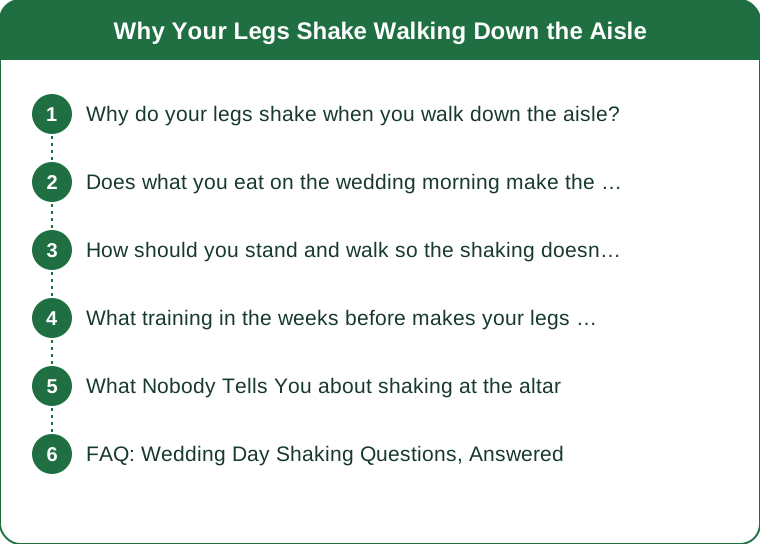
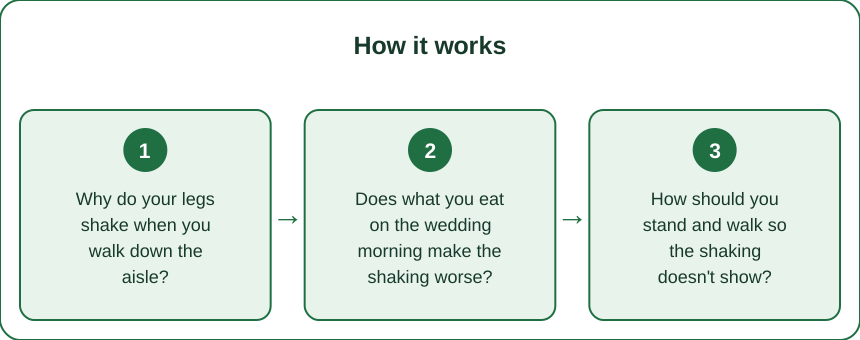
Why do your legs shake when you walk down the aisle?
Your body can’t tell the difference between a big happy moment and a threat. Both trigger a surge of adrenaline.
Adrenaline raises your heart rate, sends more blood to the large muscles in your legs, and primes them to move fast. That’s helpful if you need to sprint. Walking slowly in time with a string quartet uses almost none of that energy, so the surplus shows up as a fine tremor.
The shaking tends to peak in the first 30 to 60 seconds after the surge starts, which is roughly the length of the walk.
It’s also far more obvious to you than to anyone watching. A floor-length dress hides nearly all of it, and guests are looking at your face.
Does what you eat on the wedding morning make the shaking worse?
It can, and this is the part most brides overlook.
Wedding mornings are long. Hair and makeup often start 4 to 5 hours before the ceremony, and it’s easy to get through them on coffee and half a pastry. Low blood sugar on its own causes shakiness, weakness and light-headedness. Stack it on top of adrenaline and the trembling gets noticeably stronger.
Caffeine adds to the effect. Two large coffees on an empty stomach will amplify a tremor you’d otherwise barely feel.
A simple plan:
- Eat a proper meal with protein and slow carbohydrates 2 to 3 hours before the ceremony. Eggs on toast, yogurt with oats and fruit, or a chicken and rice bowl all work.
- Have a small snack, like a banana or a handful of nuts, about 45 minutes before.
- Keep coffee to your usual amount, or one cup less.
- Sip water steadily through the morning.
Ask a bridesmaid to be in charge of making sure you actually eat.
How should you stand and walk so the shaking doesn’t show?
A few physical habits make a large difference.
Unlock your knees. When you’re nervous you tend to stand rigid with your knees pushed back. Stiff legs tremble more, and standing locked for a long stretch can leave you light-headed. Keep a tiny bend, small enough that nobody could see it.
Breathe out longer than you breathe in. Just before the doors open, inhale through your nose for 4 counts and exhale slowly for 6. Do that 5 times. A longer exhale is one of the quickest ways to slow your heart rate.
Press your feet into the floor. Before your first step, feel your heels and the balls of both feet. Then squeeze your thigh and glute muscles hard for 5 seconds and release. Using the muscles for a moment burns off some of that extra charge.
Walk slower than feels natural. Adrenaline makes you speed up. Aim for about one step per second.
Hold the bouquet low, at your hip bones, with relaxed elbows. It keeps your shoulders down and steadies your upper body.

What training in the weeks before makes your legs steadier?
Legs that are strong and familiar with the task shake less. You don’t need much.
Practice the walk in your shoes. At least 5 sessions of 10 minutes over the last 4 weeks, on a surface similar to your venue’s. Grass, gravel, carpet and polished stone all feel different in heels. If you’ll be wearing a long dress, practice in a long skirt so you learn the small kick-forward step that keeps fabric away from your toes.
Add 3 short strength moves, 3 days a week:
- Calf raises: 2 sets of 15, slow on the way down.
- Single-leg balance: 30 seconds on each side, in your wedding shoes once it’s easy barefoot.
- Sit-to-stand from a chair: 2 sets of 10 without using your hands.
Rehearse the pause. Stand still for 2 minutes with soft knees and slow breathing. Most of the ceremony is standing, and that’s a skill too.
Stop adding anything new in the final week. Familiar and rested beats sore.
What Nobody Tells You about shaking at the altar
The walk is only the first minute. A few things are worth knowing about what comes after.
The shaking usually fades once you arrive. Adrenaline surges are short. Within 2 to 3 minutes of reaching the front, most brides feel their legs settle.
It can come back during the vows. Speaking in front of a crowd triggers a second, smaller surge. Hands tend to show it more than legs at that point, so holding your partner’s hands helps both of you.
Your partner is probably shaking as well. It’s just less visible in trousers.
Photographers rarely capture it. A tremor is movement, and a photo is a fraction of a second. What does show in pictures is a held breath and raised shoulders, so the long exhale helps your photos as much as your knees.
Cold makes it worse. At an autumn or winter ceremony, shivering and nerves add together. Stay wrapped up until the last possible moment.
FAQ: Wedding Day Shaking Questions, Answered
Is it normal to shake while walking down the aisle?
Very. It’s one of the most common things brides report afterward, and it happens to confident people as often as shy ones. It’s a physical response to adrenaline and says nothing about doubts or how ready you are.
How do I calm my nerves 5 minutes before the ceremony?
Do 5 slow breaths with a 4-count inhale and a 6-count exhale, squeeze and release your leg muscles twice, and take a few sips of water. Then pick one person or one spot at the front to walk toward. A single focus point quiets the feeling of being watched by everyone at once.
Should I switch to flats if I’m worried about shaky legs?
If you haven’t practiced in your heels, a lower block heel or flats will feel much more secure, and nobody can see them under a long dress. If you love your heels, keep them and put in the 5 practice sessions. Either way, scuff new soles on pavement first so they grip.
TL;DR:
- Shaky legs on the aisle come from adrenaline priming your muscles for action while you walk slowly.
- An empty stomach, extra coffee, locked knees, cold and unfamiliar shoes all make the tremor stronger.
- Eat a real meal 2 to 3 hours before, exhale for 6 counts, soften your knees, and walk at about one step per second.
- Practice the walk in your shoes at least 5 times and add calf raises, balance holds and sit-to-stands 3 days a week.
Almost nobody in the room will see it, and it’ll be gone a couple of minutes after you reach the front. Feed yourself, breathe out, and take the first step. If you tend to faint or feel dizzy when you stand for long periods, mention it to your doctor before the day. This is general information, not medical advice.
Keep Reading
This article is for general informational and styling purposes only. Fit, sizing, and product availability may vary.