Why Your Feet Swell by the Reception and Your Wedding Shoes Stop Fitting

Quick Answer: Feet swell through a wedding day because of long hours standing, warm rooms, salty food, alcohol, and gravity pulling fluid down into your lower legs. Feet are often up to half a shoe size bigger by evening. Try on and buy your shoes in the late afternoon, break them in for 2 to 3 weeks, build calf strength, and plan two 10 minute feet-up breaks on the day.
The shoes were perfect at the morning photos. By the ceremony they were snug. By the time dinner’s cleared and the band starts, you’re looking at your bridesmaid’s flats with real envy.
Your shoes are the same size they were this morning. Your feet have swollen, and it happens to almost every bride.

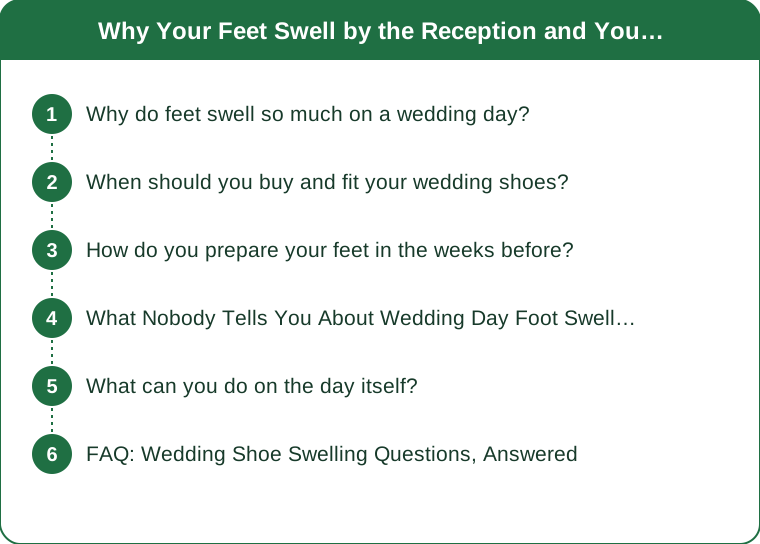
Why do feet swell so much on a wedding day?
Feet get a little larger over any normal day. Fluid settles in the lower legs as the hours pass, which is why shoe fitters suggest shopping in the afternoon.
A wedding day stacks several causes on top of that.
- Standing still. Photos, the ceremony, the receiving line. Your calf muscles act as a pump that pushes fluid back up your legs, and they only pump when you move. Standing in place for 40 minutes lets fluid pool.
- Heat. Warm venues, layers of fabric, and nerves all widen blood vessels in the skin, and more fluid moves into the tissue.
- Salt and champagne. Canapés and catered meals tend to be salty, and alcohol encourages fluid shifts and dehydration at once.
- A long day. Many brides are on their feet for 10 to 12 hours.
Put together, a change of up to half a shoe size by evening is common, and the foot gets wider more than it gets longer.
When should you buy and fit your wedding shoes?
Shop after 3pm, on a day you’ve been walking around. Morning feet are the smallest feet you’ll have all day, and they’re the wrong ones to fit for a reception.
A few fitting rules help.
- You should have about a thumb’s width between your longest toe and the end of a closed-toe shoe
- The widest part of your foot should sit in the widest part of the shoe with no bulging over the sole
- If you’re between sizes, go up the half size and add a slim insole or heel grip for the morning, which you can remove later
- Adjustable straps and soft leather or satin uppers give more room to work with than stiff synthetic ones
Bring the shoes to your dress fitting too. Hem length is set to that exact heel height, so the pair you fit in should be the pair you wear.
How do you prepare your feet in the weeks before?
Start 2 to 3 weeks out, earlier if the heel is higher than you normally wear.
Break the shoes in. Wear them indoors with thin socks for 20 to 30 minutes a day, building to an hour. Do some of that in the evening, when your feet are at their largest. Walk, stand, and climb a few stairs in them.
Build your calf pump. Stronger calves move fluid better and tire later.
- Calf raises: 3 sets of 15, rising for 2 counts and lowering for 3, every other day
- Single-leg balance: 30 seconds per side in bare feet, daily
- Ankle circles: 10 each direction, per foot
Practise the standing. Wear the shoes while you cook dinner or do your makeup trial. Standing is harder on feet than walking, and it’s most of what you’ll do.
If your day involves a long outdoor ceremony, rehearse on a similar surface. Grass and gravel change how a heel behaves.

What Nobody Tells You About Wedding Day Foot Swelling
The second pair should be the same heel height, or close. If you change from a 3 inch heel into flats, your dress hem can end up dragging on the floor by that same 3 inches. Choose a comfortable block heel or wedge of similar height for the evening, or ask your seamstress about a bustle or wrist loop that lifts the hem.
Numbing sprays and painkillers hide warnings. If you can’t feel a blister forming, you can’t stop it. Use blister plasters and anti-friction balm on known rub points before the day begins.
Ten minutes with your feet up changes the evening. This is the fix brides are most surprised by. Lying back with your feet on a chair above hip level lets pooled fluid drain. Schedule it once after photos and once before the reception entrance.
Tights and stockings can help or hurt. Light compression styles support circulation. Hold-ups with tight bands at the thigh do the opposite for some people. Test yours on a full day first.
Open-toe shoes are more forgiving. Swelling shows most across the forefoot, and an open toe or a strap you can loosen gives it somewhere to go.
What can you do on the day itself?
Small habits through the day add up.
- Drink water steadily. Aim for a glass with breakfast, one before the ceremony, and one for every alcoholic drink
- Go easy on very salty snacks in the morning
- Keep the shoes off until you actually need them. Get ready in slippers
- Move during standing stretches. Rock gently from heels to toes or do small calf raises under your dress. Nobody can see, and it keeps the pump working
- Take the two feet-up breaks
- Sit for dinner with your shoes loosened or slipped off under the table
- Pack a small kit: blister plasters, anti-friction balm, gel forefoot pads, and your second pair
If your shoes have straps, start the day on the usual hole and expect to move out one hole by evening.
FAQ: Wedding Shoe Swelling Questions, Answered
Should I buy wedding shoes a half size bigger?
If you’re between sizes or the shoe feels snug in an afternoon fitting, yes. Add a removable insole or heel grip for the morning and take it out when your feet swell. If the shoe already fits comfortably late in the day, stay with that size.
How long should I break in wedding shoes?
Around 2 to 3 weeks of short indoor wears is enough for most pairs. Aim for a total of roughly 6 to 8 hours in them before the day, including some evening wear and some standing still.
Is foot swelling ever a reason to see a doctor?
Mild swelling in both feet after a long day is normal. See a doctor promptly if swelling is in one leg only, comes on suddenly, is painful, red, or warm, or comes with shortness of breath. Mention it to your provider too if you’re pregnant and notice sudden swelling. This is general information, not medical advice.
TL;DR:
- Standing still, heat, salt, alcohol, and a 10 to 12 hour day can make feet up to half a size bigger by the reception
- Fit and buy shoes after 3pm, and size up the half size if you’re between sizes
- Break shoes in for 2 to 3 weeks and train calf raises every other day
- On the day, drink water, keep moving your calves, and take two 10 minute feet-up breaks
- Choose a second pair with a similar heel height so your hem still works
Feet that swell by the reception are normal, and you can plan for them. Fit your wedding shoes for your evening feet, give your calves a few weeks of work, and book those two short breaks into the timeline. You’ll get through the last dance on your own feet.
Keep Reading
This article is for general informational and styling purposes only. Fit, sizing, and product availability may vary.