Training for a Wedding That Is Still a Year Away Without Burning Out by March

Quick Answer: A year is long enough to build genuine strength, which is something eight weeks cannot do. Spend the first eight months training for capability rather than appearance, keep the intensity moderate, and save anything that feels like a countdown for the final ten weeks.
Everyone you know got engaged and immediately started a wedding workout plan. Yours is next October.
Here is the trap. A twelve-month runway treated like a twelve-week plan produces burnout by spring and a resentful, exhausted bride by summer. The long game is a completely different sport.

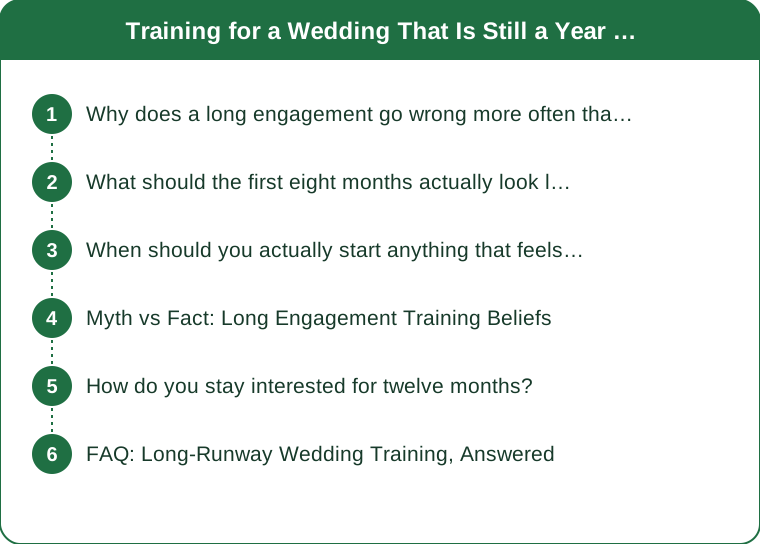
Why does a long engagement go wrong more often than a short one?
Because urgency does the work in a short timeline, and there is no urgency at month eleven.
Short countdowns succeed for a bad reason: they are survivable. Eight weeks of anything is survivable. Twelve months of a plan built on restriction and daily punishment is not, and the failure is not willpower, it is arithmetic.
The pattern is predictable. Intense start in month one. Slow drift by month three. A guilty restart in month five, usually harsher than the first. Complete abandonment by month seven, followed by panic at month ten and a crash approach in the final six weeks that leaves you exhausted for the actual wedding.
The fix is to spend your surplus time on the thing short timelines cannot buy: real strength. Muscle takes months. Skill takes months. Habits take months. Those are the assets a year gives you, and none of them require you to feel like you are in a countdown.
The second fix is to stop measuring in months remaining. Measure in what you can do. The date takes care of itself.
What should the first eight months actually look like?
Boring, sustainable and progressive. Specifically:
Three strength sessions a week, full body, built on squats, hinges, pushes, pulls and carries. Sets of 6 to 10, adding a small amount of weight or one repetition whenever a session feels comfortable. This is the entire engine of the plan.
Two easy cardio sessions, which can be walks, cycling, swimming or an easy jog. Conversational pace. Their job is recovery and general health, not calorie burning.
No deficit for the first six months. Eat enough to support the training, with protein at roughly 1.6 grams per kilo of bodyweight. Trying to build strength and diet hard simultaneously does both badly.
One deload week every six to eight weeks, where you halve the volume and keep the movements. This is the single most skipped item and the reason most long plans die around week fourteen.
Track two numbers only: what you lifted, and whether you turned up. Progress in this phase looks like a heavier squat, not a smaller number on a scale. The appearance changes are a consequence, and they arrive quietly around month five without you chasing them.
When should you actually start anything that feels like a countdown?
Ten to twelve weeks out, and not a day earlier.
That is when the plan changes character. Up to then, you have been building. From then, you are refining, and the two look quite different.
Weeks 12 to 6 out. Introduce a modest deficit if you want one, around 300 to 400 calories below maintenance, no more. Keep strength training at the same weights but reduce volume slightly, since recovery is lower in a deficit. This is also when dress fittings begin, so weight should be stable and predictable rather than dropping fast.
Weeks 6 to 2 out. Stop the deficit. Return to maintenance eating. Keep training, drop the hardest sessions. Your body will hold water and look fuller and better, which surprises people who expect the opposite.
Final 2 weeks. No new anything. No new class, no new food, no new skincare, no first-ever spray tan the day before. Maintain, sleep, walk, hydrate.
The most useful sentence in this article: the last eight weeks should be the easiest eight weeks of the entire year, because the work was already done.

Myth vs Fact: Long Engagement Training Beliefs
Myth: more time means you should aim for a bigger transformation. Fact: more time means you can aim for a realistic one and actually reach it. Extending the goal to match the timeline is how the plan becomes unsustainable in month three.
Myth: you should be in a calorie deficit the whole time. Fact: twelve months of continuous restriction reliably produces metabolic adaptation, poor training quality, low mood and a rebound. Most of a long runway should be spent eating at maintenance and building.
Myth: you need to change your plan every few months to keep the body guessing. Fact: your body is not guessing, it is adapting, and adaptation requires repeating the same movements long enough to get better at them. Change the load, not the exercises.
Myth: cardio is the fastest route to wedding-day arms and shoulders. Fact: the shape people actually want from wedding photos, defined shoulders, a strong upper back, posture that holds, comes almost entirely from resistance training. This is the item most commonly gotten backwards.
Myth: if you fall off for a month, the year is ruined. Fact: a year contains twelve months and you need roughly eight decent ones. A bad month is a rounding error, provided you restart at the same weights rather than punishing yourself with a harder plan.
How do you stay interested for twelve months?
Motivation will not last a year. Structure has to do the work instead.
Set a performance goal with a date in the middle. A 10k in spring, a bodyweight bench press, ten strict push-ups, a first pull-up. Something that arrives around month six and has nothing to do with the wedding. It gives the middle of the year a purpose, which is exactly where long plans die.
Book the sessions like appointments. Same days, same times, in the calendar. Decisions cost willpower and you have twelve months of them.
Train with someone. A partner, a friend, a class, a coach. Adherence data across every population points the same direction: people who train with others keep going.
Photograph the strength, not the mirror. A log of what you lifted is far better fuel than a progress photo, because it only ever goes up and it is not affected by lighting, water retention or your mood that morning.
And plan around the wedding admin. Venue visits, tastings, family logistics and the hen weekend all eat time. Drop to two sessions a week in those weeks rather than missing entirely. Two is maintenance. Zero is a restart.
FAQ: Long-Runway Wedding Training, Answered
Should I start dieting now if I have a lot I want to change?
Start training now and eat at maintenance for the first several months, then run a modest deficit for a defined block later. Extended dieting over a year performs worse than the same total effort concentrated into two or three shorter blocks, and it costs you the strength gains that create the shape you are actually after. If you want a deficit early, keep it to a defined 12-week block with a clear end, then return to maintenance.
When should I book my dress if my body is changing?
Most dresses are ordered six to nine months out and altered in the final two months, so the honest approach is to tell your bridal shop what your plan is. They fit and alter for a living and would far rather know. The practical guidance is to have your weight stable for the six weeks before your final fitting, which is one of the strongest arguments for ending any deficit around ten weeks out.
What if I get injured six months before?
It is a redirect, not an ending, which is one of the genuine advantages of a long runway. See a physiotherapist early rather than waiting it out, keep training everything that does not hurt, and expect to be back on track well within your timeline. A short countdown has no room for this. A year has plenty.
TL;DR:
- Treat a long engagement as a strength-building project, not an extended countdown.
- Spend the first eight months on three full-body strength sessions a week at maintenance calories, with a deload every six to eight weeks.
- Only start anything countdown-shaped at ten to twelve weeks out, and end any deficit by six weeks out so fittings are predictable.
- Set a performance goal for the middle of the year, and drop to two sessions a week during busy wedding admin rather than stopping.
The last eight weeks before your wedding should feel calm, because everything meaningful was already built. That is the whole advantage of a year, and it is only available to people who resist spending month one as though it were month eleven.
Keep Reading
This article is for general informational and styling purposes only. Fit, sizing, and product availability may vary.